


HVAC Equipment Suppliers UAE: Chillers, Spare Parts, and What to Look For in One Partner
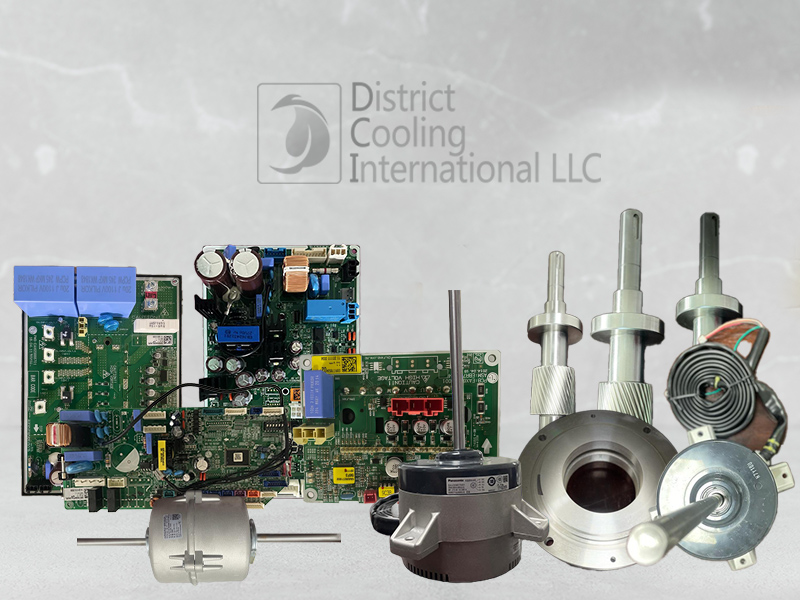
Picking an HVAC equipment supplier in the UAE is not the same decision it is anywhere else. In most markets, a cooling system runs hard for three or four months and rests the other eight. Here, it runs from February to November at temperatures that regularly push past 45°C. That is not a nuance; it changes everything about how equipment is specified, how spare parts are managed, and what a reliable supplier relationship actually looks like on the ground.
The UAE HVAC market hit USD 5.2 billion in 2024 and shows no sign of slowing down, with industry projections pointing toward USD 7.47 billion by 2034. That kind of market attracts serious operators and opportunistic ones in equal measure. Knowing which is which before you sign anything is what this guide is about.
Start With Authorization — Then Verify It Yourself
The UAE has a counterfeit spare parts problem that the industry does not talk about loudly enough. Components that look genuine get installed into commercial systems, perform adequately for a few months, and then fail in ways that take a chiller offline for days and void the manufacturer’s warranty in the same move.
Authorized HVAC equipment suppliers in the UAE have formal agreements directly with the brands they distribute. That means manufacturer-certified parts, brand-backed technical training, and a documented supply chain from factory to site. It also means accountability; an authorized distributor has something to lose if the product or service falls short.
The verification step most buyers skip is going directly to the brand’s official UAE distributor register rather than taking the supplier’s word for it. If a supplier hesitates when you ask to verify their authorization status, you have your answer before the conversation goes further.
One Supplier for the Whole System Is Worth More Than It Sounds
The instinct when comparing suppliers is often to look for the best price on each individual product type. A chiller from one supplier, VRF systems from another, spare parts sourced wherever they are cheapest at the time. On paper this looks like procurement efficiency. In practice, it creates a facility management problem that costs more to run than the savings ever justified.
A large commercial building in the UAE rarely runs on a single equipment type. The main cooling load might be handled by a centralized chiller. Perimeter offices and meeting rooms might use VRF for the zoned control that chillers cannot provide economically. Air handling units condition fresh air across the floor plates. Fan coil units distribute cooling at the room level.
When one of these fails, the diagnostic question is rarely isolated to a single unit. It involves understanding how the system interacts. A supplier covering the full range — chillers, VRF, AHUs, FCUs, DX systems, cooling towers — has that system view. One that supplied only part of it does not, and facility managers in buildings with fragmented supplier relationships know exactly how that plays out when something goes wrong under peak summer load.
Chiller Types and Why the Distinction Matters
Chillers account for the largest share of cooling capacity in commercial, hospitality, and industrial facilities across the UAE. Choosing the wrong type for a building’s load profile means either overspending on capacity that never gets used or running a system that cannot hold setpoint temperatures when outside conditions peak.
Air-cooled chillers work well for small to medium commercial applications. They are straightforward to install, do not require cooling tower infrastructure, and suit buildings where the cooling load is moderate and space constraints make water-side equipment impractical.
Water-cooled screw chillers are the standard choice for larger commercial buildings — hotels, office towers, hospitals — where the higher upfront infrastructure cost is justified by significantly better operating efficiency over the system’s lifetime.
Centrifugal chillers are built for scale. District cooling plants, airports, large retail developments, and any facility where cooling loads are measured in thousands of refrigeration tons. They are the highest-efficiency option at high load, but they are not the right choice below a certain capacity threshold.
Absorption chillers sit in a different category entirely, they recover waste heat to drive a cooling cycle, which makes them relevant in industrial and co-generation applications where process heat would otherwise be wasted.
Credible chiller suppliers UAE understand this distinction well enough to tell you which type your facility should not use, not just which one they happen to carry the most of.
Spare Parts — The Part of the Supplier Relationship That Reveals Everything
A chiller compressor failing during a Dubai summer in a commercial building is not a maintenance inconvenience. It is an operational crisis with a clock on it. Staff cannot work in 35°C indoor temperatures. Tenants escalate. Revenue-generating operations halt.
What determines how quickly that situation resolves is almost always parts availability. If the right compressor, control board, or heat exchanger is sitting in a local warehouse in the UAE, the downtime is measured in hours. If it needs to be sourced from overseas, cleared through customs, and freighted to site, it is measured in days or weeks, all while the lease runs and the complaints accumulate.
Strong HVAC spare parts suppliers UAE maintain local inventory of the components most vulnerable to failure under sustained high-ambient operation. They can confirm compatibility before anything ships. They supply OEM documentation with every component. And they do not treat spare parts as a secondary revenue line, they treat it as the part of the business that determines whether a client stays or leaves.
January 2025 saw Dubai reinforce mandatory energy efficiency standards for HVAC equipment, a regulatory shift that also increased scrutiny on whether installed components meet specification. Non-genuine parts that scrape through installation checks create compliance exposure down the line that genuine components do not.
Multi-Brand Capability Is the Differentiator Nobody Markets Loudly Enough
Most commercial and industrial facilities in the UAE carry HVAC equipment from several different manufacturers, the result of different fit-out phases, equipment replacements, and procurement decisions made across years. A supplier who can only service the brand they distribute leaves the facility manager running four separate relationships for a single building.
The best HVAC equipment suppliers in UAE carry genuine technical depth across the major brands, not just the one they are authorized to distribute. The ability to service, repair, and overhaul LG, Carrier, York, Trane, and McQuay equipment under one contract is rarer than it should be in this market, and considerably more valuable than suppliers who offer it tend to make clear.
When evaluating any supplier, ask the service question directly: which brands can your technical team work on, and what evidence can you show for it? A portfolio of multi-brand maintenance contracts is a stronger answer than a list of brand logos on a brochure.
The Right Questions Before You Shortlist Anyone
These are the questions that separate suppliers who will perform from suppliers who will present well:
-Are you an authorized distributor for the brands you supply and where can I verify that independently?
-Do you cover the full HVAC system range, or do I need separate suppliers for chillers, VRF, and spare parts?
-Is your service team in-house, or does it subcontract when a job comes in?
-Do you hold UAE-based stock for critical spare parts, or source on demand when something fails?
-What does your emergency response structure look like when a system goes down mid-summer?
-Can you provide references from facilities with similar equipment and operational requirements to ours?
The answers to these questions tell you more about a supplier than any sales presentation will.
Got a space that needs cooling? DCI supplies, installs, and maintains it. Get in touch.