


HVAC Products Suppliers in UAE: What to Check Before You Buy Chillers, VRF Systems and Split Units
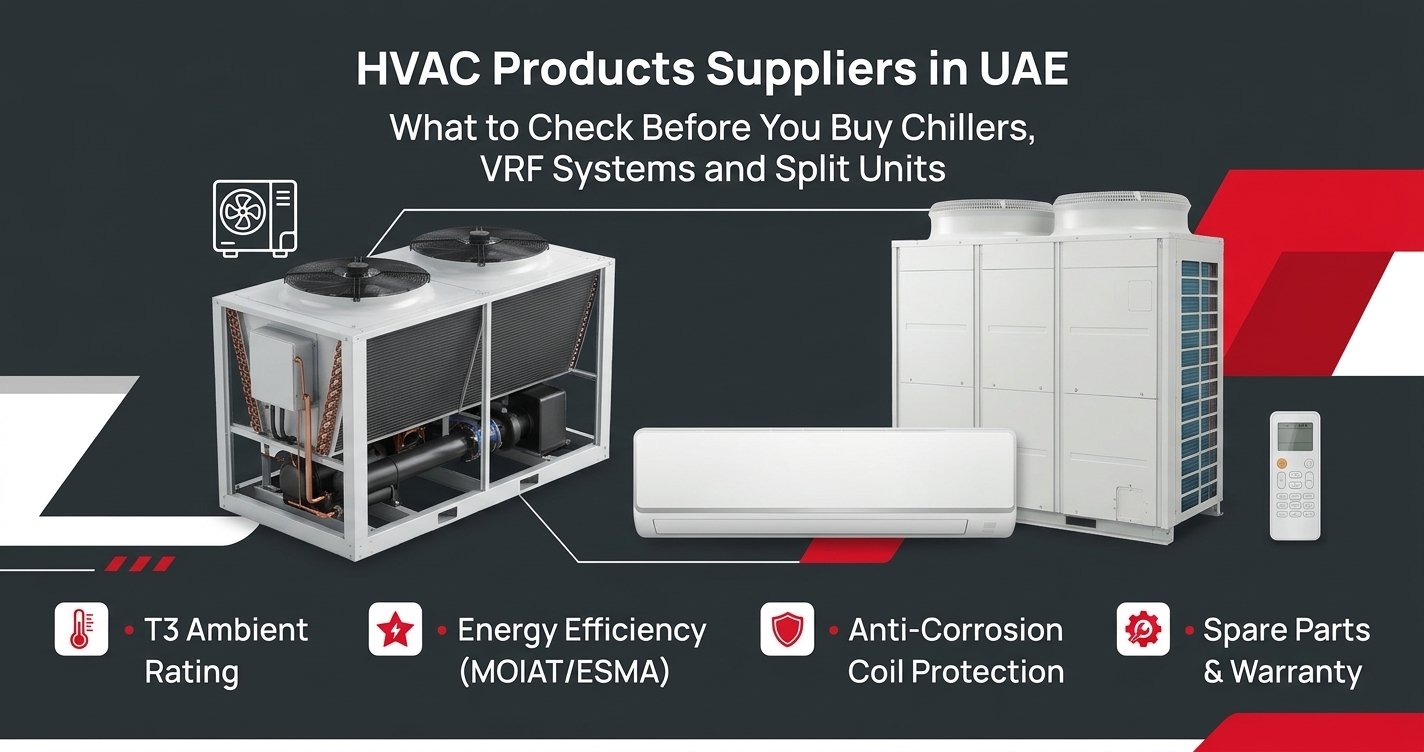
Buying cooling equipment is a decision you live with for years. A chiller that is slightly wrong for your building does not fail on day one. It simply costs more to run every month, and that cost is hard to spot until the bills add up. This guide works like a site checklist. For each type of equipment, it gives you the questions to ask, what a good answer sounds like, and the warning signs. Use it with any of the HVAC product suppliers in the UAE on your shortlist, and again when the quotation arrives.
What to Prepare Before You Ask HVAC Suppliers for Quotes
Write down three facts first, because every supplier will ask for them.
- The building and its use. An office tower, a hotel, a mall and a villa need very different systems.
- The load pattern. Engineer Stacey Ayuthia, writing in Consulting-Specifying Engineer, lists peak demand, minimum demand, the extent of load variation and the length of the cooling season as the starting points for chiller selection.
- Your limits. Space, noise, water use and maintenance budget all narrow the options.
A supplier who sizes equipment from floor area alone, without asking about any of this, is guessing.
Questions to Ask Chiller Suppliers in the UAE
DCI (District Cooling International LLC) supplies centrifugal, absorption and screw chillers in air-cooled and water-cooled versions. These four questions matter for any chiller you are quoted.
1. Should I choose an air-cooled or water-cooled chiller?
Ask: “Which one suits my site, and why?”
A good answer covers both sides:
| Air-cooled chiller | Water-cooled chiller | |
| Installation cost | Lower | Higher initial investment |
| Extra equipment | No cooling tower needed | Cooling tower, pumps, piping and water treatment |
| Best suited to | Small to medium applications | Long operating hours, where lifecycle cost matters |
| Efficiency | Drops as outdoor air gets hotter | Stays steady |
Sources: Mitsubishi Heavy Industries; Stacey Ayuthia, Consulting-Specifying Engineer.
Ayuthia notes that air-cooled chillers must work at higher refrigerant temperatures and pressures as the outdoor air gets hotter, which is worth remembering in the UAE climate.
Red flag: An answer that picks one type without mentioning space, water or running hours.
2. What is the chiller’s efficiency at part load, not only at full load?
Ask: “What are the kW/ton and IPLV figures, and how were they tested?”
A good answer gives both numbers. The US Department of Energy’s FEMP guidance explains that a lower kW/ton value means higher efficiency, that a chiller must meet both its full-load and IPLV values, and that performance is measured under the AHRI 550/590 test procedures. FEMP also warns that a chiller bought for part-load duty may end up running at full load for long periods, and the reverse can happen too, so check both figures.
Red flag: A brochure with only one efficiency number, or no test standard.
3. Which compressor type fits my load: screw, centrifugal or absorption?
Ask: “Why this type for my building, and how does it behave in daily use?”
A good answer ties the type to your load. According to Ayuthia:
- Screw chillers typically keep their design efficiency at partial loads.
- Centrifugal chillers can lose capacity at low load and risk stall or surge unless variable speed drives are used.
- Absorption chillers tend to have higher maintenance expense.
- A strict noise limit favours scroll or absorption units over screw or centrifugal ones.
Red flag: No mention of how the chiller behaves when the building is only half full.
4. How will I see what the chiller is really doing after handover?
Ask: “What metering and monitoring is included?”
A good answer includes instrumentation. Ayuthia points out that metered data lets you compare actual performance with the vendor’s performance sheet, and find out whether a gap comes from operating decisions or maintenance.
Red flag: No way of checking performance after handover.
Questions to Ask About VRF Systems
DCI is a distributor of LG VRF systems for hotels, office buildings, retail malls and mixed-use towers. A VRF system serves many rooms from one outdoor setup, so the buying questions differ from a chiller.
- Zoning: DCI describes LG’s VRF design as able to cool different spaces independently without hurting overall performance. Check that the supplier has mapped your zones to the floor layout, not just quoted a total capacity.
- Controls and BMS integration: DCI states that its LG VRF systems integrate with a building management system (BMS) and other controls. If you plan to connect one, ask which protocols and what documentation come with it.
- Technical support: DCI says its VRF systems come with full technical support and documentation. Ask exactly what that covers and who your contact will be.
Red flag: A VRF quotation with no zone list, no drawing and no commissioning plan.
What to Check When Buying Split AC Units in the UAE
DCI supplies LG split units for villas, apartments and light commercial spaces, with full manufacturer warranties. Two checks are useful here.
- The UAE energy efficiency label. The UAE’s energy efficiency label standard, UAE.S 5010-1:2014, applies to residential single package and split-system non-ducted air conditioners from 1 November 2015. The label must appear on the unit and on its packaging, and the star rating comes from the unit’s EER. Ask the supplier to show you the label and star rating for the model you want.
- The test conditions. The standard tests units at climate class T3 conditions, with an outdoor temperature of 46°C dry bulb, a reminder that ratings should reflect hot-climate performance.
Red flag: A split unit with no visible label, or a supplier who cannot say which star rating applies.
How to Compare HVAC Systems Suppliers in the UAE (Not Just Their Products)
Equipment is half of the purchase. The other half is who looks after it. When you compare HVAC systems suppliers in the UAE, use these checks.
- Spare parts availability. As an LG distributor, DCI states that it can arrange spare parts for the full range of LG HVAC equipment, including chillers and DX products. A supplier who can supply parts shortens repair time.
- Maintenance cover. DCI offers operation and maintenance contracts, chiller repair and diagnostics, overhauling and retrofits, and states that it can service equipment from Carrier, York, Trane and McQuay. A supplier who also services equipment knows how it ages.
- Written documents. Ask for the specification sheet, warranty terms and commissioning plan before you sign, not after.
For buyers searching for HVAC products suppliers in Dubai, the practical test is the same: ask about both the product and the service behind it.
Quick Checklist: Questions and Red Flags at a Glance
| Equipment | Key question to ask | Red flag |
| Chiller | Air-cooled or water-cooled, and why? | Picks a type without discussing space, water or running hours |
| Chiller | What are the kW/ton and IPLV figures, and the test standard? | Only one efficiency number, or no test standard |
| Chiller | Why this compressor type for my load? | No mention of part-load behaviour |
| Chiller | What metering and monitoring is included? | No way to check performance after handover |
| VRF system | How are zones, controls and support covered? | No zone list, drawing or commissioning plan |
| Split unit | What is the UAE energy label and star rating? | No visible label or unknown star rating |
| Supplier | Spare parts, maintenance and written documents? | No service offer or documents before signing |
Frequently Asked Questions
What should I ask an HVAC supplier before buying a chiller?
Ask about your load pattern, the chiller type and why it fits, the full-load and part-load efficiency with the test standard, and the metering included.
Should I choose an air-cooled or a water-cooled chiller?
Air-cooled chillers cost less to install and need no cooling tower. Water-cooled chillers need a tower, pumps and water treatment, but often have a lower lifecycle cost on long operating hours, according to Mitsubishi Heavy Industries.
What does kW/ton mean for a chiller?
kW/ton measures the power a chiller uses for each ton of cooling. A lower value means higher efficiency, according to the US Department of Energy’s FEMP guidance.
Do split air conditioners need an energy label in the UAE?
Yes. UAE.S 5010-1:2014 requires an efficiency label on residential single package and split-system non-ducted air conditioners, on both the unit and its packaging.
Can the same HVAC supplier provide and maintain my equipment?
Yes. DCI offers maintenance contracts, repairs, overhauling, retrofits and spare parts alongside the supply of LG chillers, VRF systems and split units.
Talk to DCI About Your Cooling Needs
If you are comparing HVAC product suppliers in the UAE and want one that can also look after your equipment, bring your load details to DCI. Explore our chillers, VRF systems, split units and maintenance services, then send your enquiry through our contact page and our team will help you choose the right system for your building.
Source: